Purpose of the report
OpenAI’s AI as a Healthcare Ally report explains how ChatGPT and related AI tools are increasingly being used by both patients and healthcare workers to navigate the complex healthcare system, interpret information, and support care decisions. It highlights emerging patterns of use and the potential role of AI as a complement to traditional healthcare rather than a replacement.
Key findings
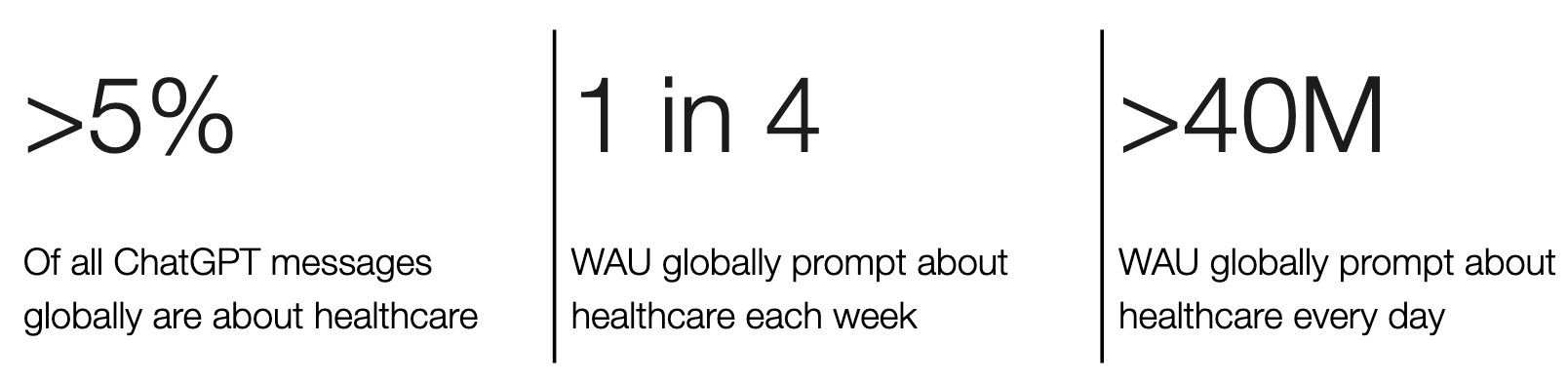
- AI usage for health questions is widespread: over 5% of all ChatGPT interactions globally are health-related; many users ask about symptoms, treatments, medications, insurance, billing and more.
- Millions of people use AI daily: Tens of millions of users (over 40 million globally) consult ChatGPT for health information each day, and roughly one in four users engages with health topics weekly.
- Health queries often occur outside usual clinic hours, reflecting demand when providers are less accessible.
- AI helps with access barriers and complexity: Users in rural or underserved areas use the tool heavily to interpret medical information and navigate administrative tasks such as insurance coverage.
- Clinicians also use AI: Many physicians and nurses report using AI for documentation, admin tasks, and clinical support, suggesting integration into routine practice.
Overall message
The report positions ChatGPT and similar large-language models as informal entry points into healthcare, helping users make sense of medical information, plan care, and reduce complexity. It frames AI as supportive and complementary to clinicians, while acknowledging the need for appropriate safeguards and professional involvement.
If AI can explain your lab results and medication instructions at 11:30 pm, what should “good” use look like, and where should the line be (education vs advice, reassurance vs diagnosis)?
If clinicians are already using AI to help with notes and messages, what do you think should be transparent to patients, and what safeguards would make you feel comfortable?
If millions of people are using AI because the healthcare system is hard to access or hard to navigate, is that a smart workaround, a warning sign, or both?
Share your thoughts in the comment section.

 JACQUELINE P. ASHBY