Ransomware & Healthcare

Bright and early this morning, I had the opportunity to facilitate an Academic Half Day (AHD) session with our UBC Department of Family Practice Abbotsford-Mission residents on an increasingly important patient-safety issue: how to respond when ransomware or a major technology outage disrupts clinical care.

We began with a roundtable exercise exploring how residents would approach a ransomware attack: Who would they immediately contact? Which tasks would be essential? What tasks needed to transfer to paper, whiteboards, and face-to-face communication? And what were the greatest risks to patient care?

Then we dove into real-world examples, including the “WannaCry” ransomware attack and the CrowdStrike outage, and examined the impact that these two events had on healthcare systems, hospitals, clinicians, and patients. I also emphasized the important role our governments and healthcare systems play in tracking and reporting these incidents, conducting thorough debriefs, and disseminating findings and recommendations following these threat-to-life crimes.

To quote Black Widow in Spider-Man: Brand New Day, “This is big, big potatoes.” 🕷️ 🤣

If you just look at the Change Healthcare (UnitedHealth Group) ransomware attack in 2024:
* Records affected: 192,700,000
* Data exposed: names, addresses, dates of birth, Social Security numbers, government ID numbers, health insurance and policy numbers, etc.
* Aftermath: UnitedHealth reported roughly USD 3.1 billion in cyberattack-related impacts for full-year 2024, the most expensive healthcare cyber incident ever recorded. (https://lnkd.in/euMYQ94u)

A key message from the session that I wanted to drive home was that we all have a role in cyber preparedness. Clinicians should be alert to any phishing attempts and clear on local downtime procedures, including knowing where approved paper resources are located, protecting patient information, and working closely with clinical, privacy, and technical teams during a disruption. These events also quickly highlight the importance in understanding how to work together as a team.

This is the first time “ransomware” has been addressed with our residents in the history of our site and I want to thank our Site Director, Dr. Holden Chow, for allowing me the opportunity to facilitate this exercise.

To the residents reading this post, I encourage you to consider focusing a quality improvement project on educating and preparing your clinic for a ransomware attack or major technology outage. The time invested in strengthening your clinic’s preparedness could ultimately help save someone’s life.

#MedicalEducation #Cybersecurity #Ransomware #PatientSafety #HealthCare #ClinicalEducation #EmergencyPreparedness

MIM

Proud to have completed Green Templeton College, University of Oxford Management in Medicine Programme, accredited by the Faculty of Medical Leadership and Management. Honestly, this two-year journey, comprising 12 sessions, was nearly as challenging as the MSc itself, but it was also an incredibly rewarding experience.

For anyone interested in the programme, I have shared a few of my favourite sessions below:

Brick Hospital, facilitated by Dr Rasmus Thøger Christensen: if you love LEGO, games, and learning more about interdisciplinary team-work and optimization of patient care, this session is for you!

Engaged Activism in Healthcare, facilitated by Dr Meera Joshi: excellent workshop that inspires one to rethink and reflect on the meaning of “activism” in the workplace.

The past, present and future of the NHS: can we keep the NHS? Faclitated by Dr Nick Fahy: this session reinforced that the foundations of our modern healthcare systems can often be traced to how earlier leaders valued the health and well-being of their constituents. Know your healthcare system’s history!

In June 2026, the Management in Medicine Programme was Highly Commended for the Empowering People Award—a well-deserved recognition. My sincere thanks to Dr Nicholas Hicks, Walid Elbaz, and the entire Management in Medicine team for such a thoughtful, engaging, and challenging experience. 🎓

CHES Presentation

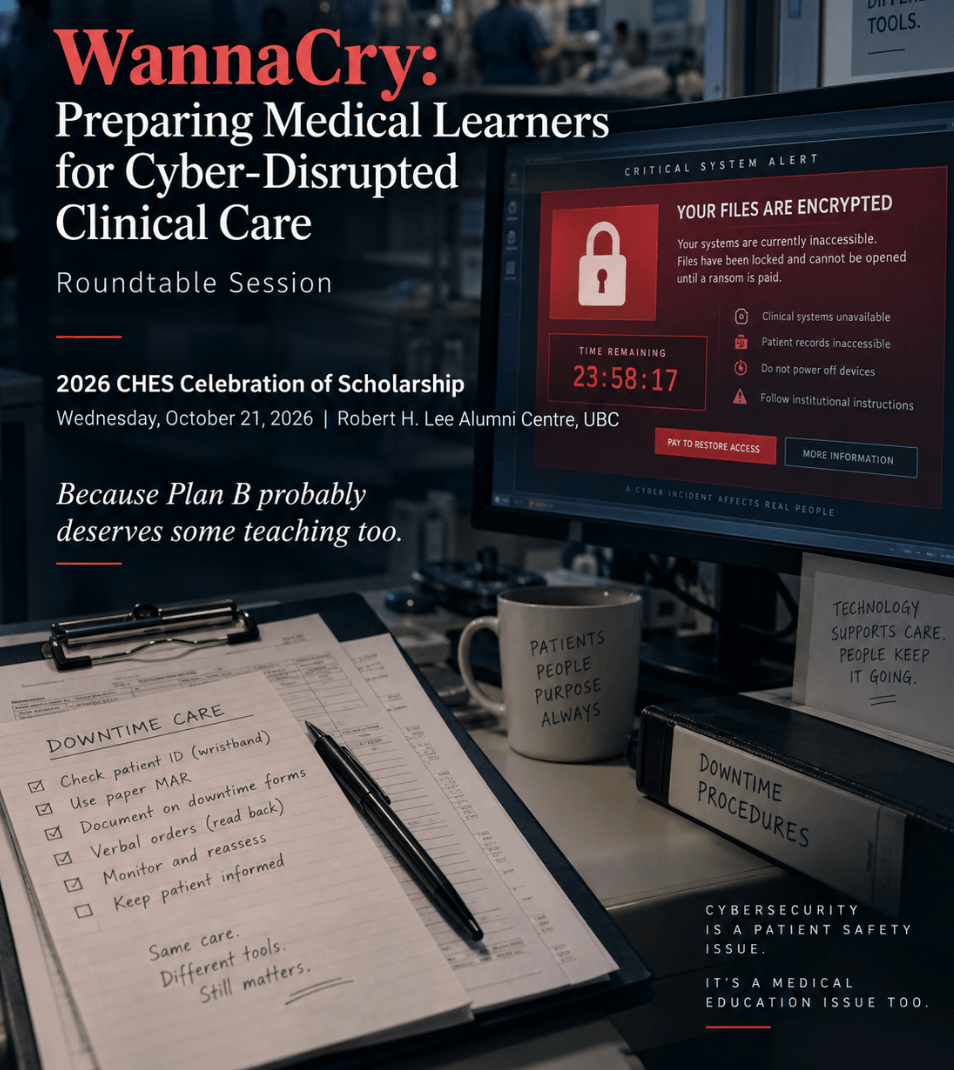
Upcoming CHES 2026 Presentation! I’m pleased to share that my roundtable session, “WannaCry: Preparing Medical Learners for Cyber-Disrupted Clinical Care,” has been accepted for UBC’s 2026 CHES Celebration of Scholarship, taking place on Wednesday, October 21, 2026.

Together with Dr. Kevin Shi, we’ll be exploring how medical education can better prepare learners and clinicians to respond when cyberattacks disrupt essential hospital and clinical systems. We hope the session will spark a practical conversation about patient safety, clinical decision-making, and the skills healthcare teams need when digital tools supporting the delivery of care are suddenly unavailable.

I’m looking forward to learning from our colleagues and discussing how cybersecurity preparedness can become a more visible part of medical education.

Learn more about the UBC CHES conference here.

Ambitious

“people who succeed tend to find one goal in the distant future and then chase it through thick and thin. People who flit from one interest to another are much, much less likely to excel at any of them. School asks students to be good at a range of subjects, but life asks people to find one passion that they will follow forever.”

― David Brooks, The Social Animal: The Hidden Sources Of Love, Character, And Achievement

“What separates ambition that elevates from ambition that corrupts, and how do you know which one is driving you? In the second installment of Yale Conversations, Presidential Senior Fellow David Brooks delivered a wide-ranging talk at Yale Jackson School of Global Affairs on the nature of ambition, desire, and what he calls “the gleam”: the fervent, luminous drive he has observed in everyone from Boys and Girls Club finalists to Tina Turner to Paul Cézanne. Drawing on philosophy, memoir, and decades of observation, Brooks traced the forces that crush passion — overintellectualization, the spirit of calculation, technological sloth, and loss of faith — and laid out the internal wrestling matches that determine whether ambition lifts us toward our better selves or pulls us toward resentment, ego, and hollow striving. A Q&A with students and faculty followed. Yale Conversations is a public forum presented by Yale Jackson School of Global Affairs in collaboration with the Office of the President.” Recorded March 31, 2026.

Outcomes

Figure 2: Cumulative incidence function curve for adverse outcomes within 30 days after hospital discharge, stratified by sedative prescription filled within 7 days after hospital discharge. Gray test: p < 0.001 for each outcome. Note that the scales of the y-axes differ. Note: CI = confidence interval, ED = emergency department.

The Medication That Follows You Home

Hospital discharge can feel like a finish line. The acute crisis has passed, the papers are signed, and the patient is finally going home.

But what follows them home matters.

A large Ontario cohort study of more than 1.8 million older adults found that 13.2% filled a sedative prescription within seven days of hospital discharge. Among those patients, nearly one-third had not been using sedatives before admission. For sedative-naive older adults, a new sedative prescription after discharge was associated with increased risk of falls, emergency department visits, hospital readmission, and death within 30 days. The strongest and most consistent signal was seen with benzodiazepines.

Many sedatives are started in hospital for understandable reasons: sleep disruption, anxiety, agitation, delirium, distress, procedures, or the general chaos of being acutely unwell. The problem is not always the medication itself. The problem is when a short-term hospital solution quietly becomes a post-discharge risk.

For older adults, discharge is already a vulnerable transition. They may be weaker, more confused, less mobile, and managing new instructions, new appointments, and new medications. Adding a sedative, especially for someone who was not previously taking one, may increase risk at exactly the wrong moment.

The bigger lesson is about transitions of care. Medication reconciliation should not simply confirm what is on the list. It should ask whether each medication still makes sense for the patient who is leaving hospital, not just the patient who was admitted.

Sometimes safer care begins with one small question:

Does this medication need to follow the patient home?

Read more on Association between sedative prescriptions after hospital discharge and falls and other adverse events in older adults: a population-based cohort study via CMAJ.

Quick Reflection Quiz

An older adult was not taking sedatives before admission but is discharged with a new benzodiazepine. What should this trigger?

A. Routine discharge with no further action
B. A structured medication review and fall-risk reassessment
C. Automatic long-term continuation
D. Reassurance that short-term use is always safe

Which group appeared to have the highest concern in this study?

A. Older adults newly started on sedatives after discharge
B. Younger adults discharged from hospital
C. Patients continuing all pre-existing medications
D. Patients discharged without medication changes

What is the key discharge-planning question raised by this study?

A. Can we prescribe something to help sleep?
B. Can the patient afford the medication?
C. Does this medication still need to follow the patient home?
D. Did the patient receive printed instructions?

What might be a practical safety step?

A. Add sedatives to all discharge bundles
B. Avoid discussing fall risk unless the patient has fallen before
C. Arrange early follow-up to reassess need, side effects, and mobility risk
D. Assume medication reconciliation is enough

Answers: 1. B, 2. A, 3. C, 4. C

PFD

Hero Alert 📣 : Sailors ⛵ Brian Angus & Dorothy Stauffer

First, I want to say this clearly: please wear a life-jacket when you head out on the water. Whether you are on a stand-up paddleboard or a boat, you need to be prepared for the unexpected.

If you are planning to charter a boat in British Columbia and are unfamiliar with our waters, I can tell you from personal experience that conditions at sea can change quickly. A calm day can become dangerous within an hour, and what feels routine can suddenly become life-threatening.

Our waters are also extremely cold. If you end up in the water, hypothermia can become a real risk. A life-jacket is essential, but it will not keep you warm. If you plan to swim or be in the water for any extended period of time, a wetsuit or dry suit is not optional. It is safety equipment.

Second, I want to send a huge thank you to Royal Van sailors Brian Angus and Dorothy Stauffer, who were first on the scene after a charter boat sank off the B.C. coast.

Because of their extensive emergency training, sailing experience, and quick action, three people were saved. As they described in their interview, they responded as emergency responders would: dividing the urgent tasks, staying focused, and working together as a team.

They also shared carrying the emotional weight of that moment, knowing they had lost sight of two people and had to make the heartbreaking decision to keep moving forward. I hope that, as time passes, the heaviness of making that call begins to lift.

If you live near the sea, I highly recommend learning to sail. Sailing is a wonderful skill, and in moments of crisis, that knowledge and confidence on the water can become vital in helping others get home safely.

I also recommend watching Brian and Dorothy’s interview with Global News, as they share several important lessons drawn from their insights and experience: https://globalnews.ca/video/11943890/saving-3-people-whose-boat-sank-off-the-b-c-coast

I strongly encourage everyone who spends time on or near the water to take a course in first aid and CPR.

And wear the life-jacket.
Every time.


#WaterSafety #BritishColumbia #EverydayHeroes #LifeJackets #Community #SafetyFirst

Public Health

On Sunday, I had the pleasure of watching some wonderful student presentations on the topic of public health communication from our Primary Compassionate Care Initiative, PCC-KWASU cohort. I was so impressed by their presentations and the ideas shared.


A few pearls that I gathered:

Communication is a form of medicine. When done effectively, it has the power to change behaviour and potentially save lives. When done poorly, or with the intention to harm, it can create additional stress, confusion, anxiety, mistrust, and anger.

During an outbreak, communicating early, consistently, and with empathy helps build public trust.

The difference between misinformation and disinformation matters. Disinformation is strategically used to exploit people, while misinformation may be shared without intent to harm.

Public health messaging should also recognize that people can be educated and uninformed, or informed and uneducated. This distinction matters when we think about trust, access, and how messages are received.

Oh! And I learned a new word! Infodemic. An infodemic is an overabundance of accurate and inaccurate information that spreads rapidly during a crisis or disease outbreak.

Congratulations to the presenting groups:

Group 1, Foundations & Audience Analysis: Abdulfatai Abdulsalam, Fadheelah Oluwabukola Bello, Simbiat Abdulrazaq, Halimatu Sadiya Ademuyiwa, and Hibatullah Tiamiyu.

Group 2, Message Design & Interpersonal Communication: Opeyemi Sabiu, Faidat Opemiposi Salman, Olamilekan Babatunde, and Hassan Abdulkareem.

Group 4, Risk Communication & Crisis Planning: Hikmat Ogunlana, Maryam Odeyemi, Aishat Hadi, and Elijah Matthew.

Group 5, Misinformation & Digital Media: Abdulroheem Olatundun, Regina Jimoh, Oluwabukola Alegbe, and Oreoluwa Fatolu.

A huge well done to all of you.

Ph.D.

Postcards to Humanity: My Ph.D. Life

This week I attended Green Templeton College, University of Oxford student presentations and one of them posted a cartoon illustrating how her Ph.D. process felt. It resonated with me as I’m sure many others in the room.

Her description also inspired me to depict my own Ph.D. experience and the challenges I encountered. It reminded me of the Banksy incident, where he intended to present and revise his own work in real time, and even for him, it didn’t go quite as anticipated.

During the Ph.D. process, you often begin with something meaningful to you. It may be somewhat fragmented or ambitious, but it’s something you’ve worked hard to shape in the form of a question, a problem, or an opportunity. Then it enters the world of feedback, scrutiny, agendas, edits, restructuring, and more edits. At times, it can feel as though the original work is being taken apart piece by piece, as if Picasso has gotten his hands on it, and through a multitude of different and opposing lenses your work evolves into something that’s more reflective of a community as opposed to an individual.

Yes, research is about producing knowledge and attempting to answer the unanswered. However, it’s also about developing resilience, humility, patience, and the ability to stay connected to the purpose of the work and the objective at hand, even when the process feels uncomfortable and, at times, absolutely miserable. That is precisely when the debts and doubts creep in. But I will never forget the advice I received from my mentor when I was in the thick of it: Jacqueline, a good thesis is a done thesis!

So, for anyone in the middle of revisions, a dissertation, a thesis, a manuscript, or any project that is being closely reviewed: keep going.

Push through. Stay with it. Protect the heart of the work.
And to Banksy, the balloon is still there :).

#PostcardsToHumanity #PhDLife #AcademicWriting #Research #RevisionProcess #DoctoralJourney #HigherEducation