

When cannabis companies talk about patients, it’s worth asking: is it about care, or about capital? Revolutionary Clinics offers a case study.
Co-founder & Chief Strategy Officer Ryan Ansin described his interest as wanting “to learn about how patients and customers could better rely on what is going into their bodies.” But the public record tells a different story — not of healing, but of holdings. What emerges is an intersection of real estate and “medicine,” where terms like “patients” and “care” are co-opted as branding tools. Property deals and capital tables shaped the company more than clinical expertise.
The paper trail shows how intertwined nonprofits, for-profits, and trusts were in shaping Revolutionary Clinics’ rise and its subsequent collapse:
- Nonprofit Wrapper: The original “Certificate of Registration to Operate a Registered Marijuana Dispensary” was filed by the Cardiac Arrhythmia Syndromes Foundation (CAS Foundation), a nonprofit used to satisfy early Massachusetts rules. In its own filing, the foundation admitted: “The CAS Foundation’s Chief Executive Officer, Chief Operations Officer, and Chief Financial Officer have no prior experience in providing services for marijuana for medical purposes” (p. 12). Link.
- Management company: At the very same address “9 Bartlet Street, #335, Andover, MA” sat CD Services of America, LLC, the for-profit management company running Revolutionary Clinics. In SEC Form D filings, it classified itself as an “Other Health Care” company (SEC Form D). Officers listed included Robert Bohlen, Lillian Montalto, Tyler Richards (all real estate), and G. Ryan Ansin (SEC Form D).
- Mailbox headquarters: The listed address for both CAS Foundation and CD Services of America, LLC corresponds to a UPS Store mailbox. CAS address & CD Services address.
- Property ties: Revolutionary Clinics’ Fitchburg cultivation mill was leased through One Oak Hill, LLC, with the G. Ryan Ansin Irrevocable Trust (2015) listed. Mr. Ansin also served as co-founder and CSO of Rev Clinics and as a CD Services manager. Link
- Blurred lines: CAS CEO Jayne Vining simultaneously sat on the board of Revolutionary Clinics. Link.
- Shifting filings: By 2019, SEC Form D filings began listing every officer with “Ryan” as a middle name: https://www.sec.gov/Archives/edgar/data/1676511/000167651119000002/xslFormDX08/primary_doc.xml
Five years later, the Worcester Business Journal captured the fallout (link):
- Rev Clinics placed into receivership with millions in debt
- Fitchburg’s 146,000 sq. ft. facility closed
- Leominster dispensary fire-sold for $500,000
- Somerville location couldn’t find a buyer
- Federal tax audit underway; $20M+ owed to creditors
The Form D Trail: What C D Services of AMERICA’s SEC Filings Raise, and What They Do Not Prove
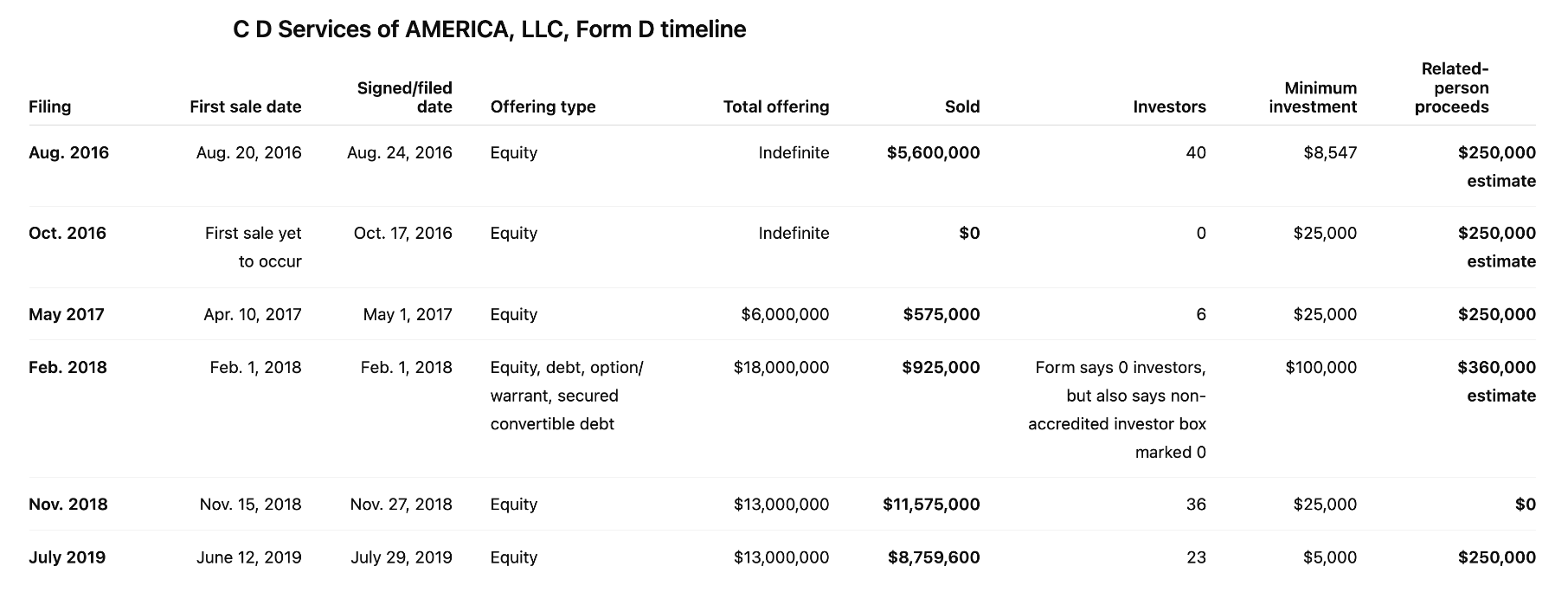
Private companies can raise money before they have revenue. That part is not unusual. Startups, health ventures, cannabis companies, biotech firms, and real estate projects often sell equity or debt based on a future business plan rather than current sales. But when a company repeatedly raises capital while reporting “No Revenues,” later shows signs of dramatic growth, and then its visible Form D trail stops, the filings deserve a closer look.
C D Services of AMERICA, LLC, a Massachusetts limited liability company formed in 2015, filed a series of SEC Form D notices between 2016 and 2019. Across six filings, the company reported approximately $27.43 million in securities sold. That figure is the sum of the “total amount sold” reported in the filings, not an audited total of capital raised. Form D filings are notices of exempt securities offerings, not full financial statements. The SEC also states that it has not necessarily reviewed the information in these filings and does not determine whether the information is accurate and complete.
The pattern begins in August 2016, when C D Services reported an indefinite equity offering, $5.6 million sold, 40 investors, a minimum investment of $8,547, and $250,000 in estimated gross proceeds proposed for related persons. The same filing selected “No Revenues” under issuer size and claimed the Rule 506(b) exemption. A second 2016 filing followed in October, also for an indefinite equity offering, but this one stated that the first sale had not yet occurred, with $0 sold and 0 investors.
The sequence continues in 2017 and 2018. In May 2017, the company reported a $6 million equity offering with $575,000 sold to 6 investors. In February 2018, the offering structure broadened to include equity, debt, option or warrant rights, and secured convertible debt, with an $18 million total offering and $925,000 sold. Then, in November 2018, the numbers changed substantially: a $13 million equity offering, $11.575 million sold, 36 investors, and $0 reported for related-person proceeds.
The July 2019 filing is the one that stands out most. It reported another $13 million equity offering, with $8.7596 million sold, 23 investors, a much lower minimum investment of $5,000, $250,000 in sales commissions, and $250,000 in proceeds proposed for related persons. It also listed a first sale date of June 12, 2019, but was signed on July 29, 2019, which appears to fall outside the usual 15-day Form D filing window based on the dates on the form.
The most unusual documentation issue appears in the related-person names. In the 2018 filing, related persons include Gregory Ryan Ansin, Robert M. Bohlen, Tyler Richards, Keith W. Cooper, Lillian Montalto, and Anatoli Tomaszczuk. In the 2019 filing, the list changes to Gregory Ryan Ansin, Bob Ryan Bohlen, Tyler Ryan Richards, and Lillian Ryan Montalto. In other words, in 2019, every listed related person suddenly has “Ryan” as a middle name. That may be clerical. It may be a data-entry error. It may have an innocent explanation. But it is still a filing irregularity, because it affects multiple named individuals in the same document.
The concern is not that a company raised money without revenue. That can be normal. The concern is the broader pattern: repeated private offerings, large amounts sold, “No Revenues” selected across filings, related-person proceeds appearing in several filings, changes in the structure and economics of the offerings, a possible late 2019 filing, and a conspicuous naming anomaly in the related-person section. If the company later stopped filing Form Ds and then reportedly experienced extraordinary growth, the natural question becomes: what changed?
The key issue is disclosure. Form D does not tell us what investors were promised, what private offering materials said, how the company valued itself, what risks were disclosed, or whether related-party payments were fully understood by investors. It also does not tell us whether later growth came from operations, debt, licensing value, restructuring, new investors, affiliated entities, or other financing arrangements.
So the cautious conclusion is this:
C D Services of AMERICA’s Form D filings do not prove misconduct. But they do create a documented timeline that raises legitimate questions. From 2016 to 2019, the company reported roughly $27.43 million in securities sold while repeatedly presenting itself as having no revenues. The 2019 filing is especially notable because it combines fewer investors, a lower minimum investment, sales commissions, related-person proceeds, and the unusual “Ryan” middle-name anomaly. For anyone trying to understand the company’s later growth, the Form D trail is not the whole story, but it is a very important place to start.
And then there are the basic questions:
- How does a nonprofit founded on cardiac arrhythmia syndromes pivot into selling marijuana gummy bears? Notable considering that there are a number of peer-reviewed articles linking cannabis use to various arrhythmias.
- Why were licenses granted to foundations and businesses with no cannabis experience?
- And most importantly: where were patients in all of this?
In the end, Revolutionary Clinics looked less like a clinic, and more like a case study in capital over care.
Update on Revolutionary Clinics and CD Services of America, LLC (2026):
In ACT Protective Services, LLC v. CD Services of America, LLC et al., filed August 5, 2024, CD Services and Revolutionary Clinics II are defendants. The docket is currently listed as open. https://www.docketalarm.com/cases/Massachusetts_State_Superior_Court_Middlesex_County/2481CV02068/ACT_Protective_Services_LLC_vs._CD_Services_of_America_LLC_et_al/
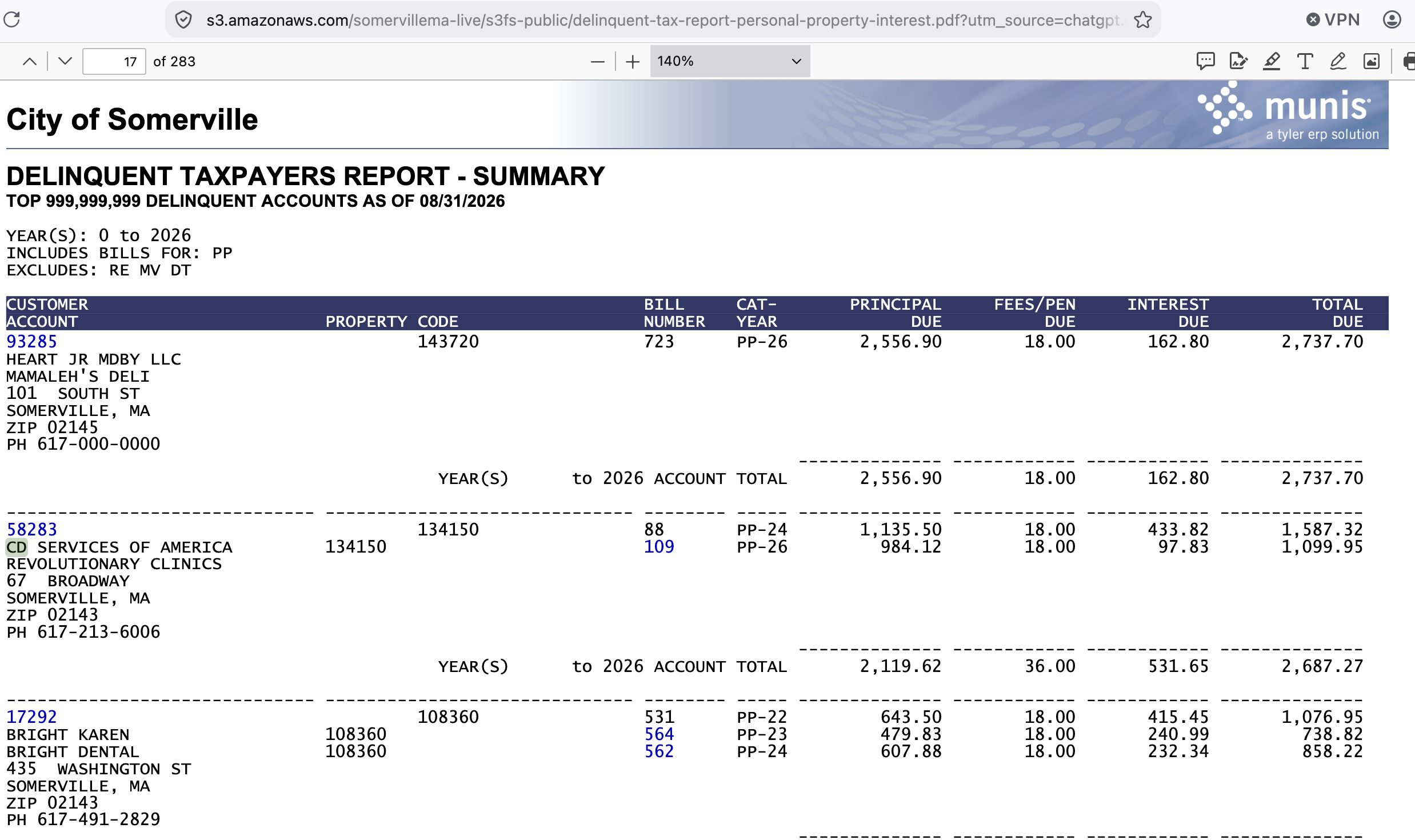
The City of Somerville’s September 2025 delinquent-tax report lists CD Services of America / Revolutionary Clinics at the Somerville Broadway location with unpaid personal-property taxes: https://s3.amazonaws.com/somervillema-live/s3fs-public/delinquent-tax-report-personal-property-interest.pdf
In Nidus Capital Holdings, LLC et al. v. Atlantic GPS, LLC et al., CD Services of America, LLC is named as a “Reach & Apply Defendant.” Trellis lists it under “Other Parties” alongside Briarleaf LLC, Alfred Boylan, GPM II LLC, and Great Eastern Attleboro LLC. https://trellis.law/case/25017/2581cv00891/nidus-capital-holdings-llc-et-al-vs-atlantic-gps-llc-et-al
David Madoff, the court-appointed receiver for Revolutionary Clinics II, together with Keith D. Lowey, the collateral agent, against Albert Einstone’s MA LLC and Solar Therapeutics, Inc. https://trellis.law/case/25025/2584cv00648/david-madoff-court-appointed-receiver-vs-albert-einstne-s-ma-llc
References:
Ansin, R. (2022, January). “I wanted to learn about how patients and customers could better rely on what is going into their bodies.” Azuca Partner Spotlight. Azuca. https://azuca.co/january-2022-newsletter/?utm_source=chatgpt.com
Request for a Certificate to Registration to Operate a Registered Marijuana Dispensary by Cardiac Arrhythmia Syndromes Foundation (CAS Foundation): https://www.mass.gov/files/documents/2017/08/bbx/cas-foundation-mop-1-redacted.pdf
SEC Form D (Filing 2019-07-30). Officers’ middle name changed to “Ryan”: https://www.sec.gov/Archives/edgar/data/1676511/000167651119000002/xslFormDX01/primary_doc.xml
SEC Form D (Filing 2018-11-28). Bartlett Street Address shared with CAS:
https://www.sec.gov/Archives/edgar/data/1676511/000167651118000001/xslFormDX01/primary_doc.xml
Jayne Vining link as board member of Revolutionary Clinics: https://masscannabiscontrol.com/wp-content/uploads/2018/11/PL-EXECUTIVE-SUMMARY-REVOLUTIONARY-CLINICS-II-MCN281507-MPN281425.pdf
Revolutionary collapse: The rise and fall of the once-largest cannabis employer in Central Mass. https://www.wbjournal.com/article/revolutionary-collapse-the-rise-and-fall-of-the-once-largest-cannabis-employer-in-central
Massachusetts Cannabis Control Commission (2022): https://masscannabiscontrol.com/wp-content/uploads/2022/10/MR284246_Revolutionary-Clinics-II-Inc..pdf?utm_source=chatgpt.com
SEC Form D Filing “Other Health Care”: https://www.sec.gov/Archives/edgar/data/1676511/000167651118000001/xslFormDX01/primary_doc.xml
Paulraj, S., Upreti, P., Tamirisa, K., & Batnyam, U. (2025). Arrhythmias and cannabis use: A comprehensive overview. Heart Rhythm O2, 1, 78–85. https://doi.org/10.1016/j.hroo.2024.12.002


Leave a Reply