
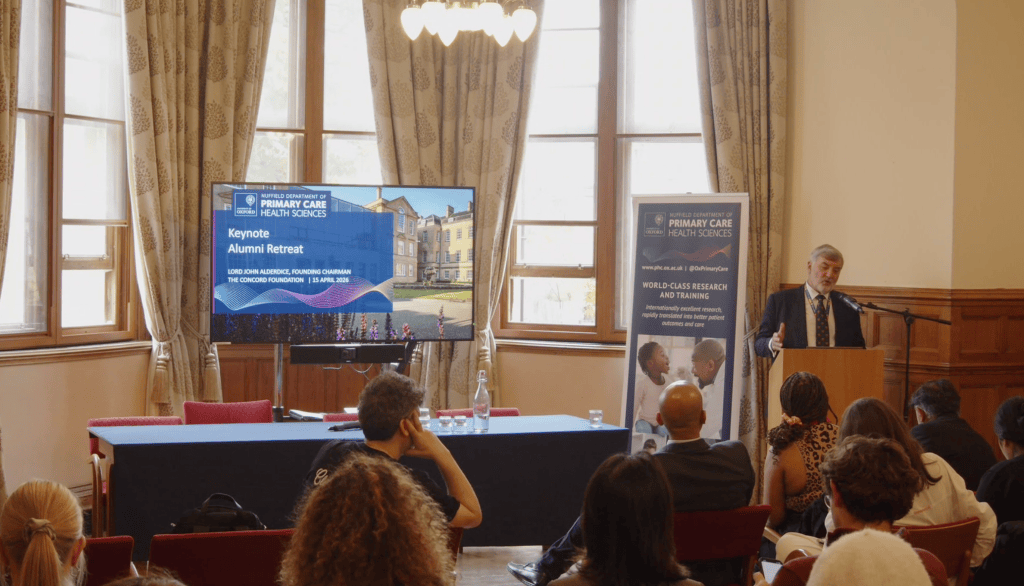
Lord John Alderdice’s lecture this morning left me thinking deeply about conflict, hope, and the relationships that shape both communities and institutions. These are difficult issues to navigate right now, and he did a beautiful job weaving his personal observations and experiences into what we’re witnessing today.
One idea stood out in particular: we often assume that political violence, social division, and destructive behaviour are driven by rational actors. But as he suggested, the deeper issue is often a damaged relationship saturated in humiliation, fear, exclusion, and compounded by the distortion of how communities see one another and themselves. And as he described, when a damaged and distorted history exists between communities and collectives, the feelings of anger and rejection can carry on for generations.
His reflections on Northern Ireland were especially powerful. Structural solutions matter, but they are not enough on their own. As he explained, you cannot simply design the “right” system or model and expect conflict to disappear. The first step is understanding the relationship and what events unfolded.
I see this clearly in our healthcare systems. We often think a new paradigm will change how people work together, when what is actually required is a much deeper dive into the transactional relationships among healthcare providers, the services rendered, and the patient. If people feel humiliated, dismissed, or treated unfairly, those experiences endure. And it is these emotions that shape the architecture of behaviour, identity, and trust.
I was also struck by his framing of what I keep thinking of as the physics between people: how human beings influence one another, how relationships create fields of meaning, and how the quality of those relationships can either deepen division or create the conditions for repair.
There was realism in his words, but not cynicism. Hope was not presented as naive optimism. It was something more disciplined: the choice to remain constructive, to engage across difference, and to build relationships even with those we disagree with. Disagreement is necessary in unpacking the different perspectives people bring to the topic. It also brought to mind the German-American psychologist Kurt Lewin, associated with field theory, who is often quoted as saying, “If you truly want to understand something, try to change it.”
In a time shaped by political polarization, social media distortion, and increasing intolerance, his message felt both timely and urgent: there is no replacement for human relationships. We may disagree deeply, but how we disagree matters.
For those of us in healthcare and medical education, that may be one of the most important reminders of all.
Disagreement


Leave a Reply