
I didn’t mean to start a company—I just had a school assignment.
As part of my Oxford program, I was asked to co-design a digital health innovation. But I didn’t want to write about a hypothetical idea—I wanted to build something real.
So I created WTF Lab? It’s a health data translator for people who’ve ever stared at their lab results or medication list and thought:
“What the f— does this mean?”
WTF Lab? helps patients:
+ Upload and track labs, medications, and symptoms
+ Visualize progress
+ Understand what’s actually happening in their bodies
It’s not built yet—but it’s built to matter.
I’m looking for collaborators—developers, designers, digital health thinkers, and patients—who want to make health data more human, less overwhelming, and a lot more clear.
WTF Lab? started as a school project.
Now I want to see it through.
wtflab.wtf
hashtag#buildinpublic hashtag#digitalhealth hashtag#oxford hashtag#healthtech hashtag#wtflab hashtag#healthliteracy
LOGO


Thrilled to have captured third place in our GTC GRC logo competition! Guess which one is mine? 🙂
SAFE AI
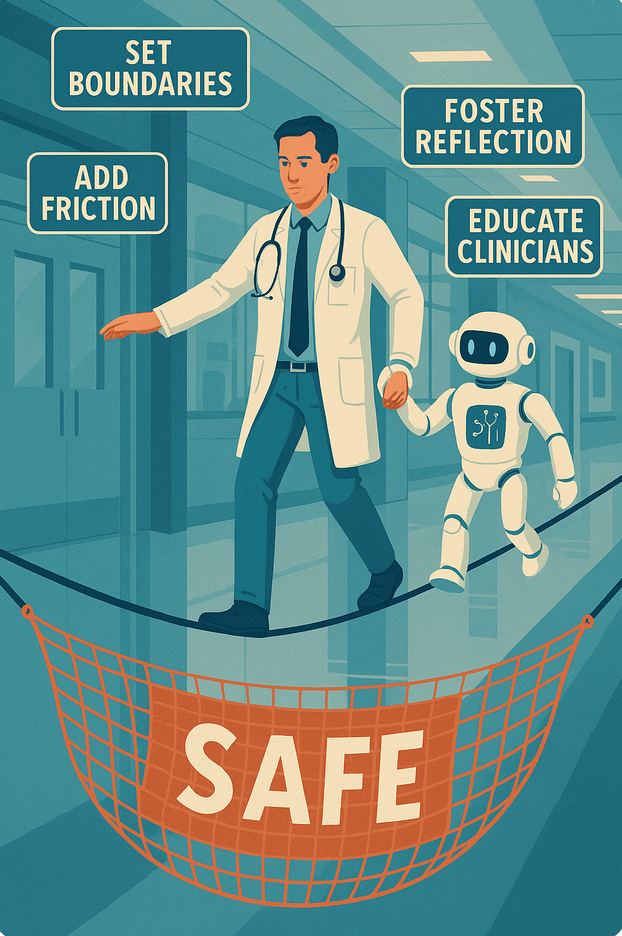
We’re entering a new era in healthcare and medical education—one where AI is increasingly integrated into tasks such as clinical reasoning and decision support. To support clinicians and educators in using AI responsibly, we developed the SAFE approach:
S: Set Boundaries: Define what AI can and cannot do in your clinical context.
1. No final diagnoses, prescriptions, or critical decisions.
2. Use for drafts, brainstorming, summaries, or language simplification.
3. Establish clinical red lines where human judgment is non-negotiable.
A: Add Friction: Prevent blind reliance with built-in checks.
1. Label all AI-generated text: “Machine-generated. Verify before use.”
2. Require human review before integrating into EMRs.
3. Add pop-up reminders or checklists before clinical use.
F: Foster Reflection: Create space for metacognition.
1. Debrief as a team: “Where did AI help us? Where did it overreach?”
2. Reflect not just on workflow, but on thinking habits.
3. Make critical thinking part of every AI-assisted task.
E: Educate Clinicians: Build AI literacy as a core clinical skill.
1. Explain how language models work—and where they fail.
2. Share real stories of hallucinations, bias, and misfires.
3. Use vignettes to spark ethical reflection and dialogue.
As this technology evolves, it’s crucial to recognize that AI is less about being “artificial” or “intelligent,” and more about automation and translation. It does not replace human judgment—it requires it.
Timing

When Should Learners Meet AI? And perhaps more importantly—how?
In this powerful piece, “We, Robots” via Persuasion, writer Kate Epstein makes a compelling case: AI isn’t just a tool—it’s a value system. And if we hand over too much too soon, we risk outsourcing not only decisions, but the very process of learning, judgment, and ethical reasoning.
As someone working in medical education, this hits close to home.
👩⚕️ Do we teach students to work with AI—or to defer to it?
⚖️ When do they learn to question, interpret, or even override algorithmic outputs?
🚩 And what happens when AI becomes more than just assistive tech, but an invisible authority?
A critical read for educators, clinicians, and anyone thinking about the future of knowledge, power, and responsibility in the age of intelligent machines.
Read more here: https://www.persuasion.community/p/we-robots
Zebra

Scientists want to understand how animals behave together in groups, like schools of fish. This study used virtual reality and robot fish to figure out how young zebrafish respond to others when swimming in groups. The researchers created a virtual world where real fish could interact with robot fish, allowing them to closely study how fish make movement decisions based on what they see.
They discovered that fish tend to follow one or more targets using a simple rule based on the fish’s own point of view. This behavior worked well even when the fish didn’t have all the information—showing how reliable it is. The team called the rule “BioPD,” a basic type of control system.
Because this kind of following behavior is important in designing self-driving vehicles (like drones or underwater robots), they tested BioPD in these systems. It worked really well, needing very little customization, which shows that nature’s simple strategies can help improve technology too.
Reverse engineering the control law for schooling in zebrafish using virtual reality via Science Robotics.
Revolutionary to Receivership

From Revolutionary to Receivership: When Cannabis Promises Go Up in Smoke
You believe in cannabis reform — health, justice, access.
You don’t believe in empty slogans.
Enter Revolutionary Clinics, co-founded by Greg Ryan Ansin.
Trauma-informed care, community wellness, healing centers — it all sounded good.
Until Fitchburg residents started filing odor complaints.
Until regulators started asking questions.
Until the apologies started piling up.
“I feel like I’ve been on an eight-month apology tour…”
Eight months of apologies?
That’s not innovation. That’s mismanagement.
What Actually Happened:
- $120,000 fine for illegal vape sales
- Four months’ probation
- Blamed the lab tech (he was fired)
- Closed their Cambridge location after a landlord lawsuit: Revolutionary Clinics, a cannabis company with a cultivation and production facility in Fitchburg and four dispensaries in Massachusetts including Leominster, is facing a lawsuit accusing the company of owing $279,570 in unpaid rent at its dispensary in Cambridge’s Central Square.
- Owes nearly $10 million — and now in receivership. Read the court filing here.
Meanwhile, in Fitchburg, the smell and the silence lingers.
This isn’t about weed.
It’s about wellness-washing — branding over safety, slogans over standards. If this were any other healthcare setting, we wouldn’t call it a “rough patch.”
We’d call it a leadership failure.
Progress means:
- Showing up.
- Owning mistakes.
- Protecting the public — not just the bottom line.
When a cannabis exec calls it an apology tour, it’s time to stop clapping and start asking hard questions.
Because real revolutions smell like change — not ethanol.
References:
Following Landlord Lawsuit, cannabis company with Fitchburg Cultivation Closes Cambridge
Revolutionary Labs Slapped with a $120,000 Fine and Probation
Revolutionary Clinics is $10,000,000 in debt.
Fitchburg cannabis firm fights odor issues as it seeks approval for renovation
Tariffs
“He that lives upon hope, dies farting.”
— Benjamin Franklin, Poor Richard’s Almanack, 1736
I’ll never forget that quote. It was September 1990, and CSUS President Donald R. Gerth opened our U.S. Government class with it scrawled across the chalkboard. A bold, memorable way to say: don’t sit around waiting — act.
I’ve carried Ben’s wisdom ever since. And I haven’t invested this much in others — or in the world — just to quietly… well, you know.
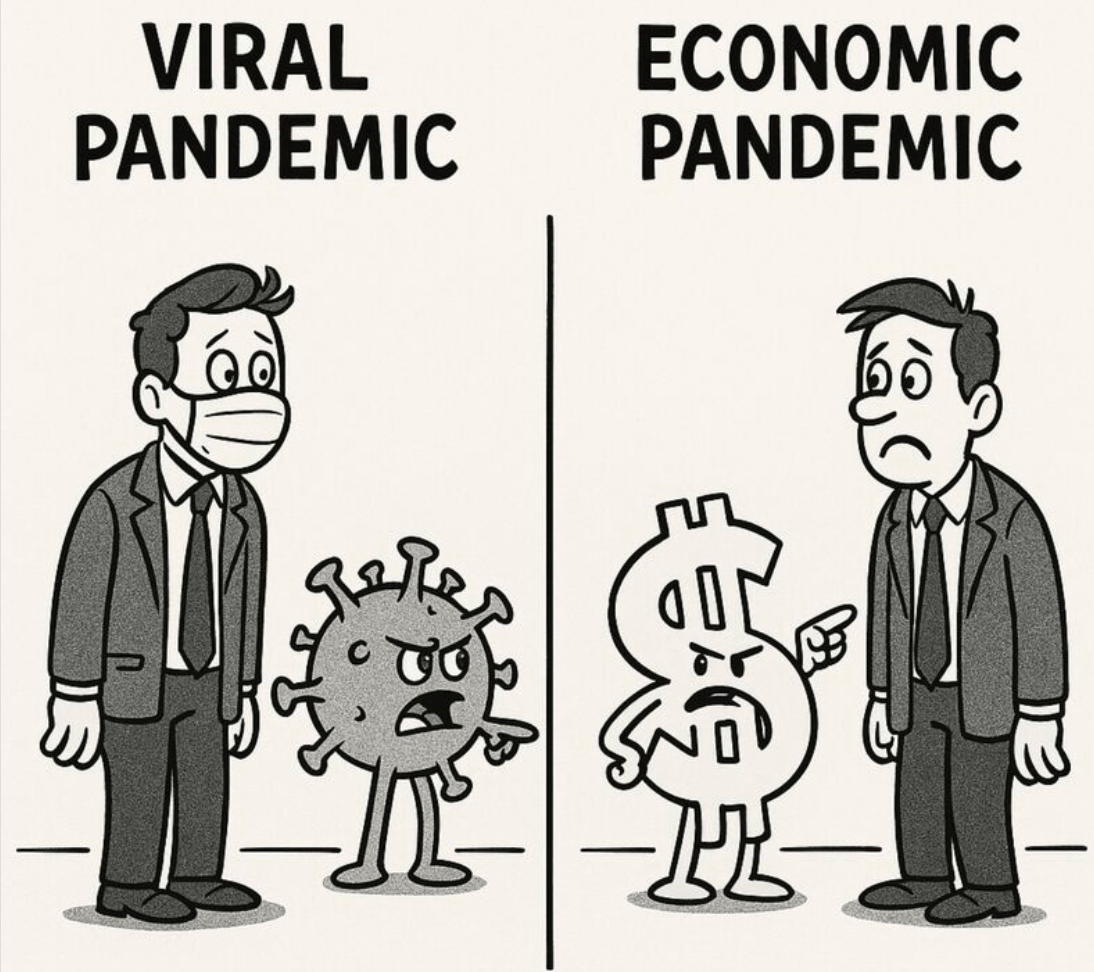
Lately, I’ve been waking up with a familiar pit in my stomach. And while I wish I could blame it on last night’s chimichanga, I know better. There’s a familiar global hum of fear and uncertainty — a déjà vu from the early days of the COVID-19 pandemic.
Only now, it’s economic.
Markets yo-yo like they’re auditioning for Coney Island. Systems are wobbling. Toilet paper is escalating in price. Borders, again, feel like more than just physical lines. The news sounds like a cross between a disaster film trailer and bad financial advice.
Both the viral and economic pandemics have exposed the same deep truth — we are inextricably interconnected. Interdependent. What happens in one corner of the globe ripples across the rest.
Despite all the tough talk, nationalism, and ideological whiplash, we need to resist the temptation to shut down — physically, economically, and emotionally. Because borders aren’t just geopolitical. They’re psychological, too. And when we wall ourselves off — from each other, from opposing views, from history — we all lose.
We need to show up differently than we did before…than we did in 2020. And part of that involves working more collaboratively across government and industry lines.
💬 1. Talk Less About the Man, More About the Mechanism
We’ve spent too much airtime reacting to personalities. Tariffs aren’t just a “Trump” issue — they’re a tool. Let’s redirect the conversation toward how these tools affect everyday people, small businesses, global trust, and economic stability. Ask: Who gains? Who pays? Who decides?
🤝 2. Reconnect Economies with Empathy
Economic policy isn’t just about numbers. It’s about people: the warehouse worker, the farmer, the startup team on their third round of layoffs. Empathy isn’t soft — it’s strategic. Let’s lead with human-centered stories, not just GDP graphs.
🌐 3. Refuse to Play the Zero-Sum Game
Tariffs fuel the narrative of “us vs. them.” But the global economy is not a tug-of-war — it’s more like a complicated game of Jenga. One bad move affects everyone. Let’s challenge oversimplified rhetoric and advocate for policies rooted in cooperation, resilience, and mutual benefit.
And let’s not forget — it’s our children who will inherit these challenges, along with all the unanswered questions and unsolved equations we’ve left on the table. So let’s sharpen our collective #2 pencils and start working through it — with the clarity, creativity, and courage this moment calls for.
Young Cancer Patients
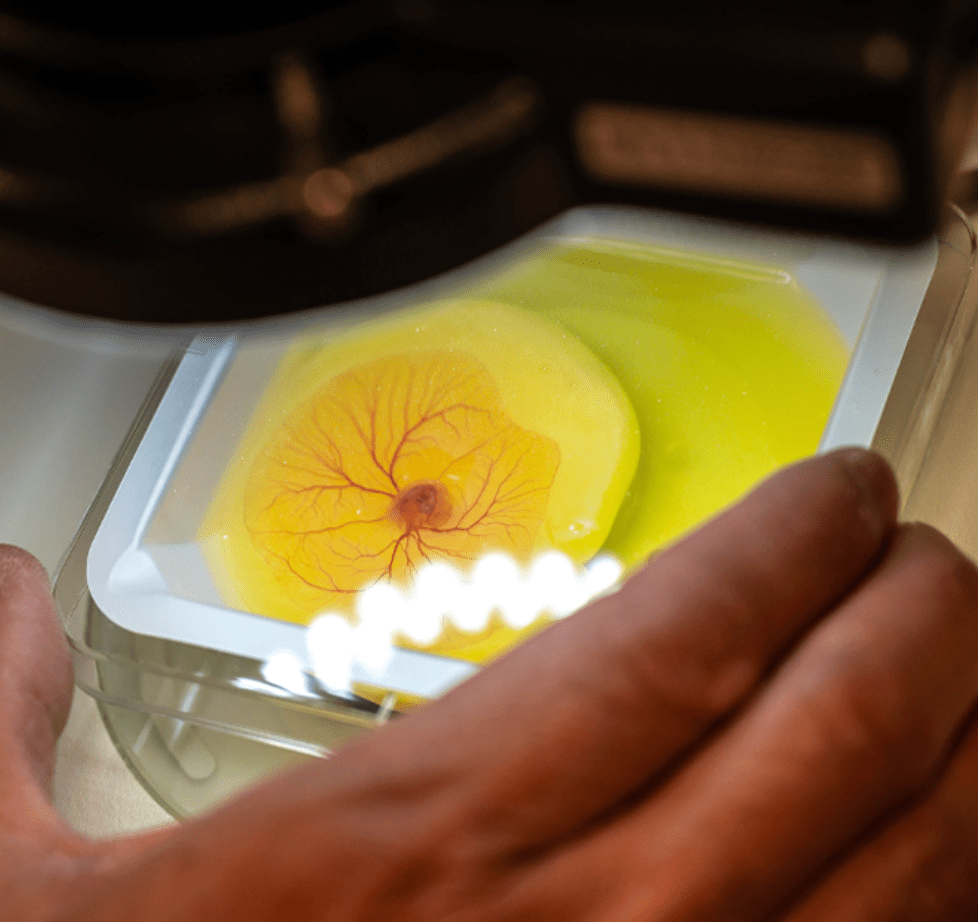
“The team, led by researchers from the UBC faculty of medicine and BC Children’s Hospital Research Institute, is the first in Canada to combine these two techniques to identify and test a drug for a young patient’s tumour in time for their treatment.
Their success in finding a new drug for the patient, described today in EMBO Molecular Medicine, shows how the study of proteins, known as proteomics, can be a valuable complement to the established study of genes (genomics) in real-time cancer therapies.
The work was a collaborative effort of PROFYLE (PRecision Oncology For Young peopLE), a key initiative of the Canadian pediatric cancer network ACCESS (Advancing Childhood Cancer Experience, Science and Survivorship) that brings together more than 30 research and funding organizations and over 100 investigators from across Canada to improve cancer outcomes for children and young adults.
The study by co-lead authors Dr. Georgina Barnabas, a postdoctoral researcher in Dr. Philipp Lange’s lab, and Tariq Bhat, a UBC faculty of medicine PhD student in Dr. James Lim’s lab, focused on an unnamed patient diagnosed with a rare pediatric cancer that resisted conventional treatments.”
Read more on Researchers develop new way to match young cancer patients with the right drugs via UBC Faculty of Medicine.
Lifeworld

🚨 BREAKING: Philosopher Jürgen Habermas saw Elon Musk coming.
(Okay, not literally—but close.)
Years ago, philosopher Jürgen Habermas dropped a concept that may explain why public discourse feels broken right now:
It’s called the colonization of the lifeworld, and it slaps harder than a trending tweet with a hidden agenda.
Here’s the gist:
🧠 The lifeworld = our shared space of meaning, understanding, & real talk.
💸 Instrumental systems = money, power, media influence.
💥 When systems hijack communication, dialogue becomes dollars. Truth becomes trending. And democracy? Distorted.
Think of it like this:
1. You don’t win the conversation—you buy it.
2. Public opinion? Not always public. Or opinion. Just really effective perception management.
3. And that colonial metaphor? Brutal and spot-on.
It’s not just encroachment—it’s forced assimilation of real conversation into PR campaigns, ad strategies, and algorithmic manipulation.
👀 Be mindful of the information being disseminated, who’s feeding it to you, what their agenda is, & more importantly how it’s shaping your thinking.
Learn more on Habermas’s notion of the public sphere…as food for thought or an intellectual nightcap: https://www.jstor.org/stable/41858870
Nibble
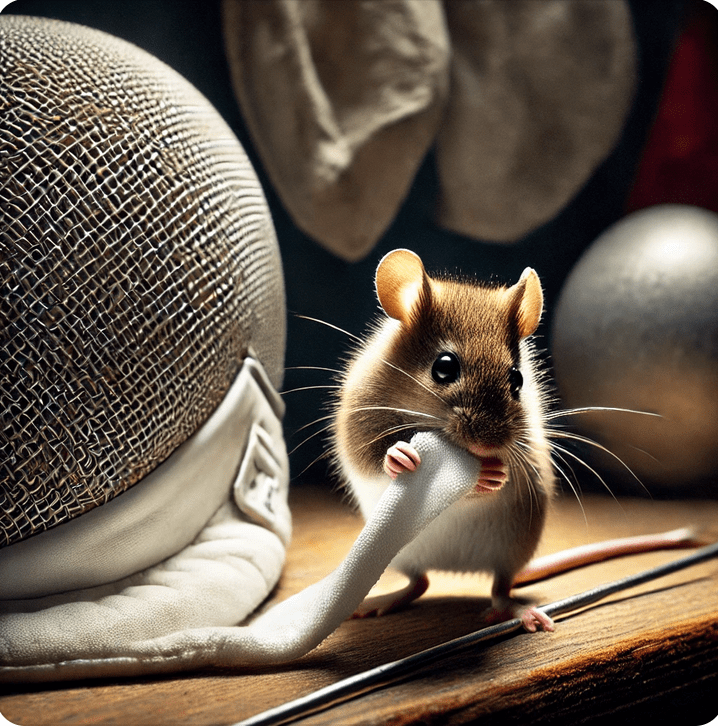
I’ve heard of several excuses as to why one can’t attend practice but hearing a mouse nibbled on my plastron is about the funniest.
Keeping your fencing gear properly stored after practice helps extend its lifespan and keeps everything fresh for your next bout. Here are five solid tips:
1️⃣ Air It Out Immediately
- After practice, don’t just shove your sweaty gear into a bag—lay it out to dry.
- Jackets, plastrons, gloves, and masks trap moisture, which leads to odor and bacteria buildup.
- Hang them in a well-ventilated area before storing them.
2️⃣ Store Your Sword Safely
- Wipe down your blade with a dry cloth to remove sweat and moisture to prevent rust.
- Keep it in a dedicated blade bag or at least separate from damp clothes.
- If using a pistol grip, check for any loose screws and tighten them as needed.
3️⃣ Keep Your Mask Fresh
- Spray the inside of your mask lightly with a disinfectant or deodorizer (or use a vinegar-water mix).
- If possible, place it in front of a fan or leave it in open air to dry fully before storage.
- Consider using a silica gel pack inside to absorb excess moisture.
4️⃣ Organize Your Bag
- Use separate compartments for wet and dry items to avoid mildew buildup.
- Consider mesh bags for gloves and socks to allow airflow.
- Keep an emergency kit inside (spare body cords, screwdriver, tape, etc.).
5️⃣ Regularly Wash Your Gear
- Machine wash your fencing jacket, plastron, and glove as per manufacturer instructions.
- Avoid using fabric softeners as they can break down the material.
- For lame jackets, hand-wash with mild detergent and air dry (never put them in the washing machine!).
Proper storage keeps your gear in top shape and saves you from dealing with stinky surprises before your next match. 🏴☠️🤺
 JACQUELINE P. ASHBY